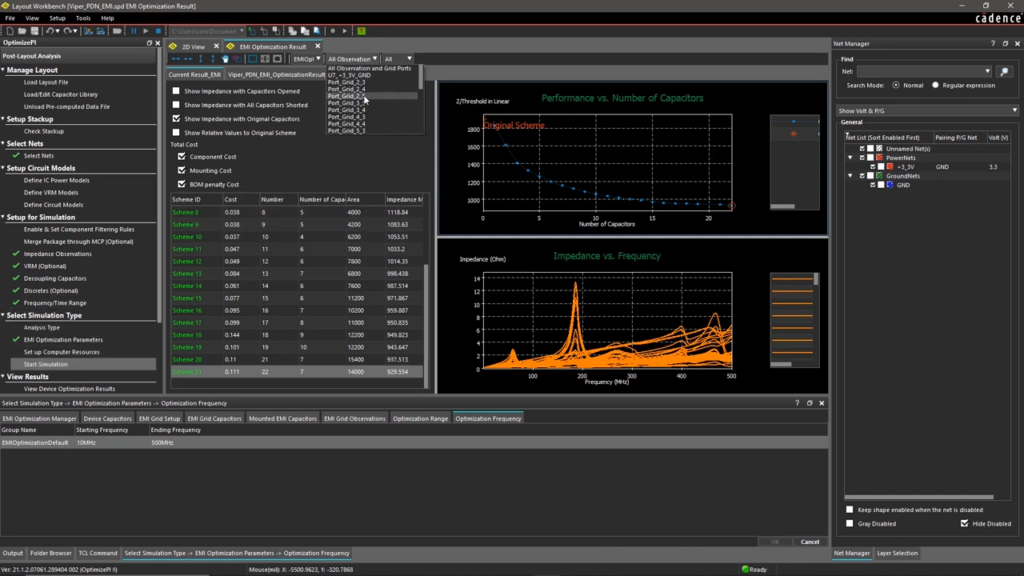
OptimizePI determines how many decoupling capacitors are needed, which types to select, and where they provide the most benefit — measured against the power distribution network's impedance rather than habit.
The number of capacitors is based on experience rather than a specific target
Too many cost money and board space on every single PCB
Too few are only discovered when the board creates noise
Support responses that take days
The solution
We give you control back
Decoupling sized against a target impedance
Fewer components where they provide no benefit
Placement evaluated together with quantity
Local hotline with responses from a specialist on the same day
HOW IT WORKS
Target impedance is the defining criterion
A target rather than a habit
The power distribution network must stay below a defined target impedance across the frequency range. That is the criterion, and that is what the decoupling scheme must deliver.
Quantity, type, and placement are interconnected
Two capacitors in the right location can achieve more than ten in the wrong one. The analysis evaluates all three aspects simultaneously.
Cost is part of the calculation
Every capacitor adds purchasing, PCB area, and assembly costs — on every single board produced. This makes the return on optimization straightforward to calculate.
VALUE
OptimizePI covers power distribution network decoupling
From target impedance and component selection to placement and the consequences of removing components.
Target impedance
Without a target, there is no way to determine whether the decoupling scheme is sufficient.
Target impedance across frequencyThe criterion the analysis is measured against
The power distribution network as a wholePlanes, vias, and components
Results versus requirementsWhere the network exceeds the target
Component selection
A capacitor is more than just a capacitance value. It is also mounting parasitics and a frequency response.
Capacitance valuesWhich values cover which frequency range
Component typesPackage and construction make a difference
Quantity per valueHow many are actually required
Placement
The location where the capacitor is placed determines whether it functions effectively at high frequencies.
Distance to the loadThe parasitic cost of the path
Vias and mountingInductance along the connection
Better placement over higher quantityThe most cost-effective change first
What-if analysis
The most valuable analysis is often the one that shows what can be safely removed.
Consequences of removalWhich components can be omitted
Alternative configurationsCompared against the same target
Cost versus marginWhat the savings mean for safety margins
In the portfolio
Decoupling is one part of power integrity, not the entire picture.
Aurora early in layoutPlacement evaluated during routing
SystemPI for the complete pictureThe power distribution network across boards
Celsius PowerDC for thermal analysisWhen current leads to temperature rise
Implementation
How OptimizePI works in practice
1. Start with a board in production
An existing design quickly reveals whether there are capacitors that provide no benefit. It is also the simplest place to evaluate the value of the optimization.
2. Guidance on target impedance
The target depends on the load and how much noise it tolerates. We provide guidance on standard industry practices and the implications of setting overly tight constraints.
3. Local expertise and continuous support
You gain direct access to specialists who understand both power delivery networks and layout design, and who can evaluate the results alongside your team.
Ready?
Ready to design with peace of mind?
A brief conversation is usually enough to clarify whether your decoupling scheme can be optimized. No pitch. No pressure. Just an open discussion about how capacitor counts are determined in your team today.
Often, yes. When decoupling is dimensioned by experience, there are typically both capacitors that provide no real benefit and areas that lack sufficient coverage. The analysis highlights both, and the savings apply to every single board produced.
The layout, stackup, and an understanding of the load requirements. We can help define the target impedance if it is not already specified by the component vendor.
They typically provide a recommendation, which serves as a sensible starting point. However, it does not account for your specific stackup, your plane split, or your available space. That is precisely where the difference between a generic recommendation and what is actually required lies.
OptimizePI focuses specifically on decoupling: count, type, and placement evaluated against an impedance requirement. PowerSI calculates the broader electrical behavior of the power distribution network, and SystemPI analyzes it across multiple boards. Most teams start with the immediate, concrete challenge, which is typically decoupling.
Contact us
Let us review your setup – without obligation.
A brief dialogue is often enough to clarify if Nordcad is the right choice for you. No pitch. No pressure.


 Sigrity X OptimizePI