Component placement is the bottleneck every PCB engineer is familiar with. Hundreds of components must be placed correctly, and a single misplacement can result in noise, EMC issues, and a redesign that delays the project by weeks.
Danfoss wanted to know if AI could eliminate the bottleneck without compromising quality. Nordcad built the system, with Cadence serving as a consultant.
In brief
The challenge
Manual component placement took four to six days per design and required three to five iterations. This pace limited how quickly Danfoss could respond to global customers.
The solution
Allegro X AI, set up and implemented by Nordcad with Cadence serving as a technical consultant. A complex project was completed without manual placement.
The result
85% shorter total design time. Engineers now spend their time on strategic decisions rather than routine placement.
The challenge
The bottleneck everyone knows about
Since 1933, Danfoss has operated according to a single principle: push the boundaries, challenge assumptions, and build a better future through engineering. For nearly nine decades, the company has been developing technologies for industrial automation and climate solutions.
But even a company with that kind of history runs into the same practical limitations as everyone else. Component placement is one of them. It’s not difficult work—it’s slow work, and it has to be done right, because a mistake won’t show up until the board has been manufactured.
For Danfoss’ engineers, the bottleneck wasn’t just time-consuming. It set a limit on how quickly development could keep pace with global customers’ expectations.
The solution
LEAP 2030 Met Allegro X AI
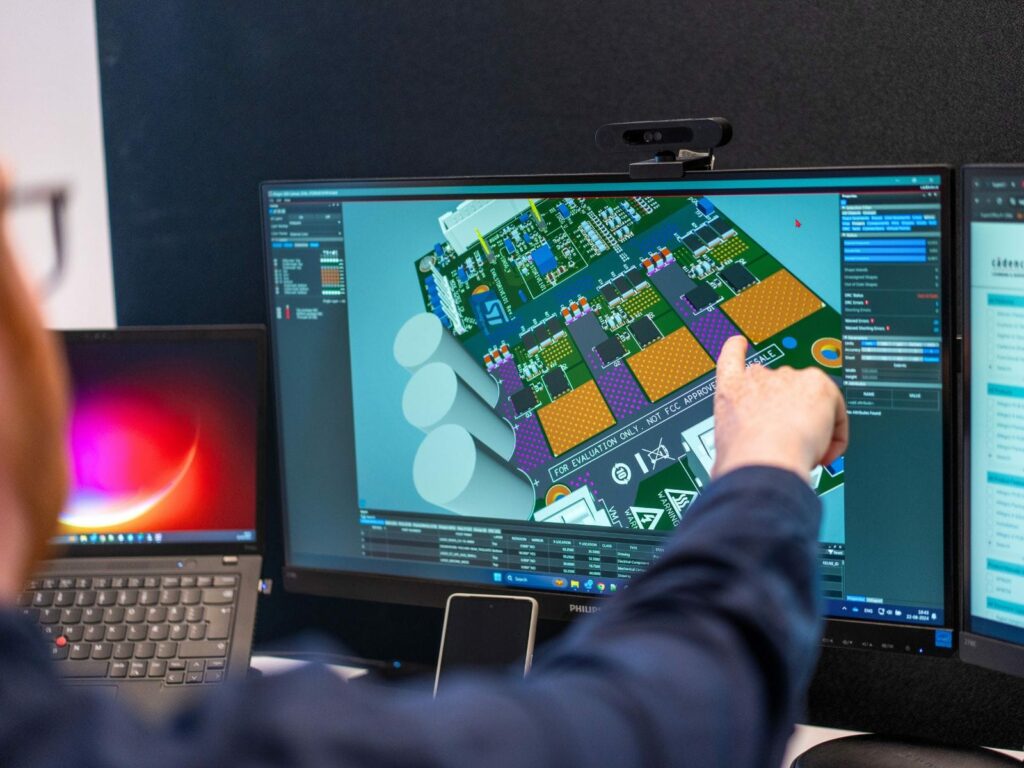
Danfoss’s LEAP 2030 strategy placed artificial intelligence at the center of how engineers would work in the future. Allegro X AI became the tool—Cadence’s AI developed specifically for PCB design optimization.
The experiment was deliberately challenging: take a complex project and have the AI handle component placement, routing optimization, and signal integrity without any human assistance along the way.
The final workflow ended up looking like this:
Setup, 30 minutes — import design specifications, configure AI parameters and naming conventions, define constraints
AI placement, 15–30 minutes — thousands of placement options are analyzed; all components are positioned simultaneously; signal integrity and power distribution are automatically optimized
Review and fine-tuning, 2–4 hours — the engineer evaluates the AI’s decisions, adjusts system blocks, and validates them against the design requirements
Final validation, 1–2 hours — automatic DRC, signal integrity verification, DFM check
“My first attempt was a big stack of guides on a board, and on my first run I ended up with a really nice layout.”
Bo Kroman, Danfoss
The result
Process Phase
Manual workflow
AI-powered workflow
Difference
Initial placement
2–3 days
15–30 minutes
95% faster
Design Iterations
3–5 rounds
1–2 rounds
70% fewer
Total time
4–6 days
4–8 hours
85% faster
But the number isn't the whole story. The biggest change was in how the engineers spent their time.
Large ICs are now placed optimally right from the first run. Decoupling improves, noise across the board drops noticeably, and signal paths are optimized along the way. The initial placement is ready for review in minutes instead of hours—so the engineer can pick up right where they left off.
“We quickly realized that there were many low-hanging fruits we could pick to streamline the process. Nordcad has been responsive to our needs, highly capable in delivering results, and skilled at asking thought-provoking questions to challenge us.
They’ve also helped automate the output, ensuring consistent results every time. Our experience with Nordcad’s support has been very positive; they’re helpful and quick to assist.”
Torsten Larsen, Danfoss
About Danfoss
Danfoss develops components and solutions for controlling heating, cooling, water, and energy, as well as hydraulics and electronics for industrial applications. The company was founded in 1933 by Mads Clausen in Elsmark on the island of Als and remains family-owned.
The company is headquartered in Nordborg, and the group employs approximately 39,000 people worldwide, including about 4,700 in Denmark. The business is divided into Power Solutions, Climate Solutions, and Power Electronics & Drives.