
 Fidelity Fine Marine
Resistance and movement determined before the hull is built
Fidelity Fine Marine simulates free-surface water, 6DOF motion, and a propeller on the same hull—so performance is known long before the towing tank and sea trials.
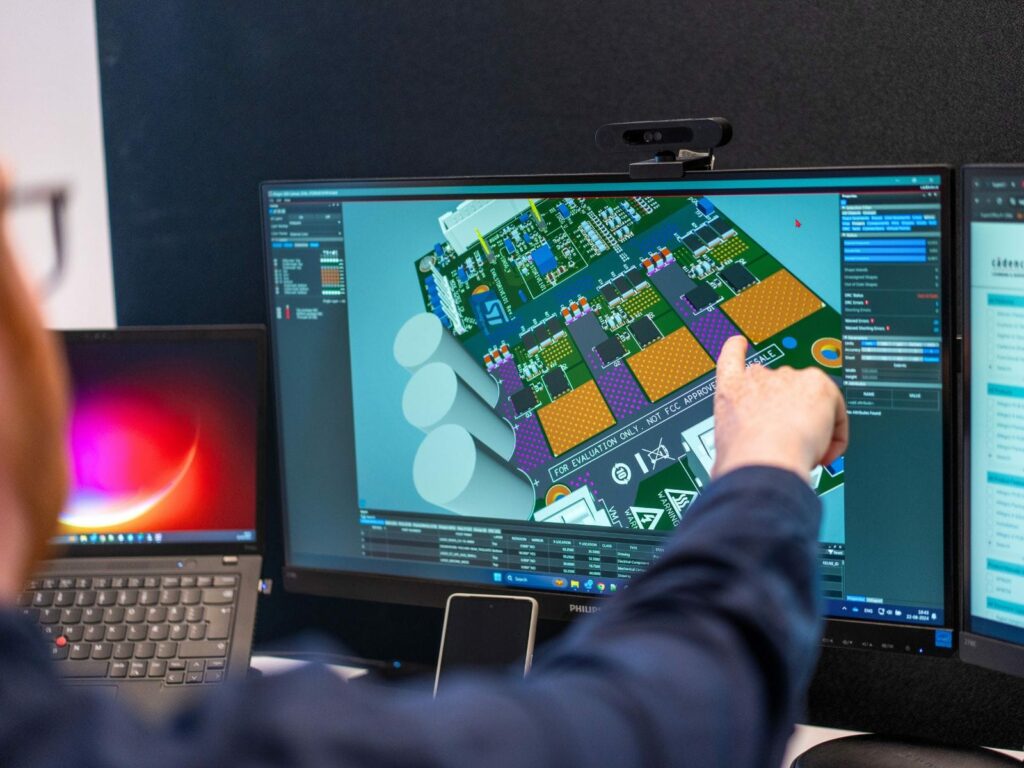
Your entire PCB flow in one tool, from schematic to 3D layout and simulation.
Try for free for 30 daysA library the design process can rely on.
PCB designFrom schematic to layout with full control.
Simulation & analysisFind the errors before the prototype does.
Thermal Simulation and AnalysisHeat accounted for from copper to enclosure.
CFD meshing & simulationThermal and flow analysis for robust designs.
RF and Antenna DesignAt high frequencies, the copper matters.
Wireless Communication & IoTRange is decided by the final millimetres.
System-Level DesignThermal and mechanical aspects calculated in time.
PLMThe current version, in one place.
Data CenterCooling determines the capacity.
Cloud ServicesComputing power when the calculation is too large.
Your entire PCB flow in one tool, from schematic to 3D layout and simulation.
Try for free for 30 daysSpecialists who work in the tools themselves.
Nordcad Customer PortalCases, licences, and downloads gathered in one place.
Software DevelopmentIntegrations and solutions that eliminate intermediate work.
MigrationFrom your legacy PCB tool to OrCAD X.
Cadence KnowledgeCadence's knowledge base with articles and guides.
Your entire PCB flow in one tool, from schematic to 3D layout and simulation.
Try for free for 30 daysYour entire PCB flow in one tool, from schematic to 3D layout and simulation.
Try for free for 30 days Fidelity Fine Marine
Fidelity Fine Marine simulates free-surface water, 6DOF motion, and a propeller on the same hull—so performance is known long before the towing tank and sea trials.
"*" indicates required fields
The challenge
The solution
HOW IT WORKS
The interface is not an add-on to a general solver, but the core of the model—and that is where the marine issues are resolved.
Shares a platform with Pointwise and Automesh. This is convenient when the hull is meshed in one place and the propeller in another.
Tow tank, PIV measurements, and full-scale sea trials. Used by America’s Cup teams and Vendée Globe participants.
VALUE
From free-surface flow and motion to propellers, cavitation, and sea states—designed to address the questions a naval architect actually has to answer.
The first question is almost always how much drag the hull creates and what it takes to move it.
The water surface is not a boundary condition. It is part of the solution, and it shifts as the process progresses.
A vessel in the lake moves in six degrees of freedom, and its motion alters the flow around it.
The propeller is both the source of propulsion and the most common source of noise, vibration, and erosion.
The value rarely lies in a single calculation, but rather in the series of calculations that determine the design choice.

Implementation
Ready?
A brief conversation is usually enough to determine whether Fidelity Fine Marine is the right choice. No sales pitch. No pressure. Just an open discussion about the types of vessels and design issues your team is working on.
FAQ
Not exactly, and that’s not the point either. Fine Marine brings the validation process forward: You can test many more variants in simulation than you could ever test in a towing tank, and use the simulation to validate the design you’ve settled on. The results are validated against towing tank tests, PIV measurements, and full-scale sea trials.
Both options are possible. For self-propulsion and cavitation analysis, the propeller is modeled as a true rotating geometry using sliding grids. For resistance tests, where the propeller is not the focus, a force model is faster and sufficient. The choice is made during setup, not in the license.
Fine Marine has its own built-in meshing capability, but many users combine the two: the hull in Fidelity Pointwise—where the CAD geometry is rarely clean—and the propeller in Fidelity Automesh. Both export directly to Fine Marine without conversion.
Fidelity Flow is the general-purpose solver for flow and heat transfer across industries. Fine Marine is designed specifically for open-surface water and for vessels moving in six degrees of freedom. Whether the question involves the hull, the propeller, waves, or seakeeping characteristics, Fine Marine is the quickest way to the answer.

Contact us
A brief dialogue is often enough to clarify if Nordcad is the right choice for you. No pitch. No pressure.


 15+ specialists